


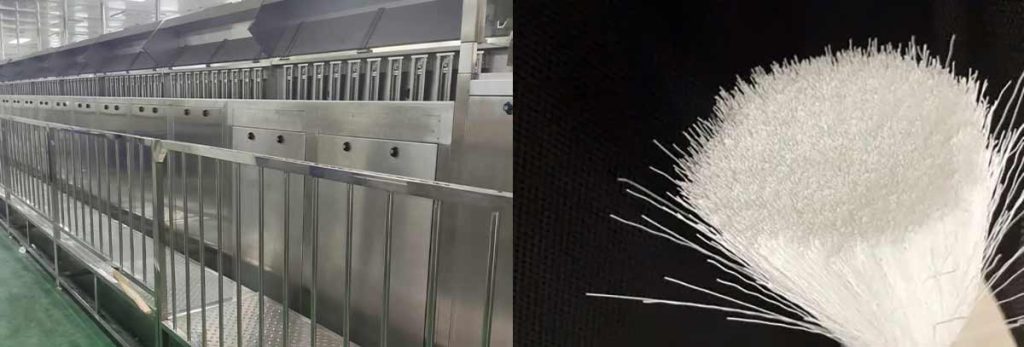
PVDF hollow fiber membrane uses a pressure-driven process to separate contaminants from water. Each hollow fiber membrane contains thousands of tiny tubes with semi-permeable walls, forming a selective barrier. The PVDF material provides strong chemical resistance and hydrophilicity, helping to block pollutants while letting clean water pass. The pore size in hollow fiber membranes determines what particles get filtered out, making the process efficient for water purification. A hollow fiber spinning machine creates these precise structures. The following table shows key performance statistics for hollow fiber membrane filtration:
| Parameter | Value/Range | Significance |
|---|---|---|
| Pure water permeance | 830–990 L·m−2·h−1·bar−1 | High, stable water flow |
| Molecular weight cut-off (MWCO) | 31.5–98.0 kDa | Effective at size-based filtration |
| Hydraulic permeability (Lp0) | 39.7–49.9 GFD/psi | Consistent filtration performance |
Key Takeaways
- PVDF hollow fiber membrane uses thousands of tiny tubes with selective walls to filter water efficiently.
- The membrane is made with strong, chemical-resistant PVDF material that helps block pollutants while letting clean water pass.
- Pressure pushes water through the hollow fibers, allowing clean water to flow and trapping contaminants outside.
- Controlling pore size and membrane structure during manufacturing ensures the right balance between filtering out particles and maintaining water flow.
- Regular cleaning and proper maintenance keep the membranes working well and extend their lifespan in water treatment systems.
PVDF Hollow Fiber Membrane Overview
Structure and Material
A pvdf hollow fiber membrane serves as a selective barrier in many filtration processes. This membrane consists of thousands of hollow fibers, each with a semi-permeable wall. The core material, polyvinylidene fluoride (PVDF), provides chemical stability and hydrophilicity, which are essential for effective hollow fiber membrane filtration. In some composite membranes, polyacrylonitrile (PAN) fibers add mechanical strength, while polyvinylpyrrolidone (PVP) acts as a pore-forming agent to enhance porosity.
The porous structure of the pvdf hollow fiber membrane features an interwoven network, confirmed by scanning electron microscopy. This network offers many attachment points, which improve functionalization and filtration performance.
The membrane’s architecture includes:
- Asymmetric and microporous design
- Ultra-hydrophilic gradient sponge microstructure
- Micronano beads network that increases from the outer to the inner surface
These features reduce water permeation resistance and boost flux during hollow fiber membrane filtration. Surface modification methods, such as blending with amphiphilic copolymers, further improve hydrophilicity and antifouling properties. The result is a membrane that resists fouling and maintains high water permeability.
| Feature | Description/Specification |
|---|---|
| Membrane Material | Gradient sponge structure PVDF hollow fiber |
| Nominal Pore Size | 0.025 micrometers |
| Fiber Diameter | 0.7 mm / 1.3 mm |
| Bacterial Removal | 99.99% |
| Permeate Quality | ≤ 0.2 NTU |
| Cleaning Compatibility | Citric Acid, NaOH, NaClO |
Manufacturing Process
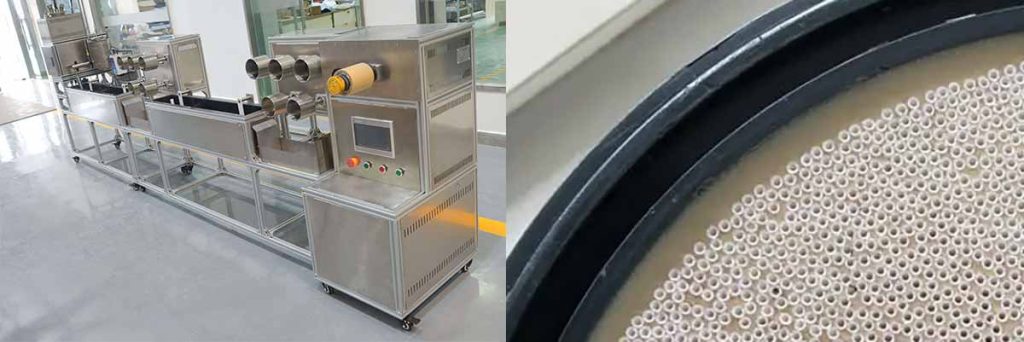
Manufacturers create pvdf hollow fiber membrane using a process called non-solvent induced phase separation. During this process, hydrophilic groups migrate to the membrane surface, which increases surface hydrophilicity and improves filtration performance. The hollow fiber spinning machine plays a central role in this process. This machine extrudes the polymer solution through spinnerets, forming hollow fibers with precise control over diameter and wall thickness.
Hollow fiber spinning machine offers:
- Adjustable spinnerets for custom fiber dimensions
- Precise temperature and pressure control
- Automated monitoring for consistent quality
Scientific studies show that spinning parameters, such as air gap distance, influence the final structure of the hollow fiber membrane. For example, increasing the air gap can create longer finger-like pores, but too much air gap may cause looser sponge structures. Manufacturers can adjust these parameters to optimize the membrane for specific hollow fiber membrane filtration needs.
Hollow fiber membrane technology has advanced to support industrial-scale production, with machines built for durability and continuous operation. These improvements ensure that hollow fiber membrane filtration remains a reliable and efficient filtration technology for water treatment and other applications.
Hollow Fiber Membrane Filtration Process
Pressure-Driven Mechanism
The core of hollow fiber membrane filtration relies on a pressure-driven mechanism. In this process, a pump or gravity creates a pressure difference across the hollow fiber membrane. Water flows through the hollow cores of the fibers, while the semi-permeable walls act as a selective barrier. This filtration mechanism allows clean water to pass through, while contaminants remain on the feed side.
Researchers have measured how pressure differentials affect filtration efficiency in hollow fiber membrane filtration. As dust or particles accumulate, the pressure drop increases. The geometry of the hollow fiber membrane, the flowrate, and the concentration of contaminants all influence this pressure drop. The hollow fiber spinning machine creates fibers with precise geometry, which helps control fluid friction and pressure loss. Accurate modeling of pressure drop is important for designing efficient filtration systems and estimating energy costs. The self-cleaning ability of hollow fiber membranes, caused by mechanical instability of the dust cake at high loading, further enhances operational efficiency.
- Pressure-driven membrane processes use pressure to push fluids through the membrane, enabling selective separation.
- The hollow fiber membrane acts as a barrier, allowing only certain molecules or particles to pass.
- Polymeric membranes, such as those made from PVDF, offer high efficiency and low energy consumption.
- The pressure-driven mechanism supports efficient fluid transport, especially in microfiltration process and ultrafiltration process applications.
- Membrane properties, including pore size and hydrophilicity, along with operational parameters, influence separation efficiency.
This pressure-driven approach forms the foundation of hollow fiber membrane filtration, making it a leading filtration technology for water purification and industrial applications.
Pore Size and Selectivity

Pore size plays a critical role in the selectivity of hollow fiber membrane filtration. The hollow fiber spinning machine enables precise control over pore size during manufacturing. The size of the pores determines which contaminants the membrane can remove. For example, in the microfiltration process, larger pores allow higher water flux but may let smaller contaminants pass. In the ultrafiltration process, smaller pores increase selectivity, capturing more contaminants but reducing water flux.
A study comparing PVDF membranes with different pore sizes found that smaller pores achieved higher contaminant removal but lower flux. Larger pores increased flux but reduced selectivity and were more prone to fouling. The interaction between feed water temperature and pore size also affected performance. Higher temperatures and larger pores increased flux but decreased contaminant rejection. The study showed that while PVDF membranes could not always meet sulfate limits, they effectively removed heavy metals. These findings highlight the importance of balancing pore size and selectivity in hollow fiber membrane filtration.
The molecular weight cut-off (MWCO) is another key factor. It defines the largest molecule that can pass through the membrane. By selecting the right MWCO, operators can target specific contaminants for removal. This selectivity makes hollow fiber membrane filtration suitable for a wide range of water purification and separation tasks.
Tip: Choosing the correct pore size and MWCO ensures optimal performance in both microfiltration process and ultrafiltration process applications.
Cross-Flow Filtration
Cross-flow filtration is a technique that enhances the performance of hollow fiber membrane filtration. In this method, water flows tangentially along the surface of the hollow fiber membrane, rather than directly through it. This flow pattern helps sweep away particles that accumulate on the membrane surface, reducing fouling and maintaining stable flux.
Studies have shown that increasing cross-flow velocity and using aeration (bubble-induced cross-flow) improve fouling control in PVDF membranes. Operating below the critical flux reduces irreversible fouling, while fine bubbles generate higher cross-flow velocities, further enhancing performance. Membrane cleaning restores permeability close to initial values, confirming that fouling remains reversible under optimized cross-flow conditions.
Another study demonstrated that cross-flow filtration with PVDF-TiO2 modified membranes significantly reduces protein fouling and maintains higher flux compared to unmodified membranes. Improved hydrophilicity and careful control of operating pressure help sustain long-term operation. This approach, combined with membrane modification, provides practical guidance for sustainable fouling control in hollow fiber membrane filtration.
- Cross-flow filtration reduces fouling and extends membrane life.
- Stable flux ensures consistent water purification and separation.
- Operators can optimize hydrodynamic conditions to achieve the best results.
Hollow fiber membrane technology, supported by advances in the hollow fiber spinning machine, continues to improve the efficiency and reliability of hollow fiber membrane filtration for water treatment and industrial separation.
Advantages of Hollow Fiber Membrane
High Efficiency
A hollow fiber membrane offers outstanding efficiency in filtration processes. Its unique structure, created by the hollow fiber spinning machine, provides a very high surface area-to-volume ratio. This design allows hundreds of square meters of membrane area in a small volume, which increases mass transfer and separation efficiency. Operators can achieve high productivity and scalability because each fiber contains multiple microscopic channels. The membrane operates at low-pressure differentials, often below 1 bar, which reduces energy consumption compared to other filtration methods.
The advanced fabrication process, such as c-TIPS, produces PVDF hollow fiber membranes with porous surfaces and excellent mechanical strength. These features result in high flux and stable operation, especially in direct contact membrane distillation.
The following table highlights key performance statistics that confirm high water permeability and stable flux:
| Performance Metric | Value | Description/Significance |
|---|---|---|
| Water Flux (FO/PRO) | Up to 40.3 L/m²·h | High water permeability in osmosis processes |
| Water Permeability (A) | 9.22 × 10⁻¹² m/(s·Pa) | Indicates ease of water passage |
| Operational Stability | Withstands up to 9 bar | Confirms robust and stable flux under pressure |
| NaCl Rejection | > 99.99% | Maintains selective permeability |
Durability and Resistance
PVDF hollow fiber membrane shows remarkable durability and chemical resistance. Research demonstrates that composite membranes, such as PVDF-SiO2-HDTMS, maintain high contact angles and tensile strength even after long-term exposure to harsh chemicals. In stability tests, these membranes showed only a minimal decrease in CO2 absorption flux after 20 days in alkaline solutions, while other types lost much more efficiency. The addition of superhydrophobic SiO2 nanoparticles protects the PVDF substrate from chemical corrosion, preserving the membrane’s structure and function. Mechanical tests confirm that these membranes retain their strength and flexibility, even after prolonged use.
Compact Design
The compact design of the hollow fiber membrane makes it ideal for many applications. The integration of materials like MOFs and clay nanoparticles further increases the surface area and porosity, enhancing adsorption capacity and selectivity. Electrospun PVDF nanofiber membranes achieve very high porosity, around 93%, and maintain strong mechanical stability.
- High surface area-to-volume ratio supports efficient water treatment.
- Consistent rejection rates above 99.9% demonstrate reliable operation.
- Compact modules save space and simplify installation.
The hollow fiber spinning machine enables precise control over fiber diameter and uniformity, resulting in membranes that combine mechanical stability with high performance. This compact and efficient design supports superior desalination and environmental remediation.
Applications and Maintenance
Industrial and Water Treatment Uses
PVDF hollow fiber membrane supports a wide range of water treatment applications. Industries and municipalities rely on these membranes for microfiltration and ultrafiltration processes. The hollow fiber spinning machine enables precise control over membrane structure, which is essential for consistent filtration.
- PVDF/PSF hollow fiber membranes modified with TiO2 particles improve oil-water separation, making them valuable for treating oil-contaminated wastewater in both municipal and industrial settings.
- Municipal sewage and industrial wastewater treatment plants use PVDF membranes produced by thermally induced phase separation (TIPS) for water recycling and advanced purification.
- Veolia’s ZeeWeed ultrafiltration hollow-fiber membranes operate in thousands of municipal, industrial, and commercial water treatment facilities worldwide. These systems handle drinking water treatment, wastewater treatment, tertiary treatment, water reuse, and industrial feedwater pretreatment.
| Aspect | Application Example |
|---|---|
| Microfiltration | Removal of suspended solids and microplastics in municipal water treatment |
| Ultrafiltration | Pathogen and virus removal in industrial and municipal water purification |
| Nanofiltration | Advanced separation of dissolved contaminants in chemical processing |
| Reverse Osmosis | Desalination and high-purity water production |
These applications demonstrate the versatility and effectiveness of hollow fiber membrane filtration in meeting strict regulatory and quality standards.
Maintenance Tips
Operators must maintain PVDF hollow fiber membranes to ensure reliable water treatment and long service life. Industry analysis shows that these membranes offer chemical resistance and thermal stability, but fouling remains a challenge. Regular cleaning and monitoring help sustain filtration efficiency.
Tip: Use chemical cleaning agents like sodium hypochlorite (NaOCl) sparingly and at recommended concentrations. Excessive or frequent chemical cleaning can degrade hydrophilic additives, causing increased hydrophobicity and reduced membrane performance.
Routine inspection for pressure drops and changes in water flux helps detect early signs of fouling. Operators should follow manufacturer guidelines for cleaning cycles and avoid harsh chemicals that accelerate membrane aging. Proper maintenance extends the operational lifespan and reduces downtime in water treatment systems.
Performance Optimization
Optimizing the performance of hollow fiber membrane systems requires a balance between cleaning frequency and chemical exposure. Scientific studies reveal that UV irradiation and high concentrations of NaOCl can alter membrane permeability and structure. Operators should adjust cleaning protocols based on water quality and fouling rates.
- Monitor water flux and pressure regularly to identify performance changes.
- Schedule preventive maintenance to address fouling before it impacts filtration.
- Use surface modifications and composite membranes to enhance fouling resistance and maintain high microfiltration and ultrafiltration efficiency.
Leading manufacturers, such as Arkema and Pall Corp., continue to improve membrane design for better durability and lower environmental impact. By following best practices, operators can achieve consistent water purification and reliable treatment outcomes.
Conclusion
PVDF hollow fiber membrane delivers reliable filtration through their unique structure and advanced fabrication with the hollow fiber spinning machine. Their high mechanical strength, chemical resistance, and antifouling properties support long-term use in diverse applications. The table below highlights their effectiveness:
| Aspect | Evidence Summary |
|---|---|
| Filtration Performance | High retention ratios, strong water flux, and robust fouling resistance |
| Application Scope | Suitable for microfiltration, reverse osmosis, and membrane bioreactors |
Regular maintenance ensures these membranes continue to provide efficient and sustainable filtration.